Where Primavera P6 is genuinely strong
P6 is the reference tool for a reason. Its CPM engine handles very large activity networks across multi-project structures with resource and cost loading, baselines, and rigorous schedule quality analysis — capabilities refined over decades of use on the world's biggest infrastructure and energy programmes. On major projects, owner contracts frequently mandate P6 schedules and P6-format submissions, which makes it not just a tool but a contractual language. Experienced planners have deep, hard-won fluency in it, and claims and forensic-delay practice is built around its conventions.
(For clarity: Primavera P6 is a product and trademark of Oracle Corporation. Gantivity is built by DashFlow Solutions and is not affiliated with Oracle; this comparison is factual and reflects the products' publicly known characteristics.)
The pain points teams actually report
- Cost. Licensing, training, and the specialist headcount to operate it add up quickly — hard to justify below the mega-project scale, and a real line item even there.
- Complexity. P6 assumes a trained scheduler. The interface, the database administration, and the update discipline it requires put it out of reach of PMs and site engineers — by design, but with consequences.
- The scheduler bottleneck. In practice the programme becomes one specialist's file. Every update, every what-if, every question queues behind that person. When they leave or rotate, institutional knowledge goes with them.
- Disconnect from site. Site teams never touch P6. Progress travels from the work face through diaries, chat, and spreadsheets before a planner keys it in — weekly or monthly. The programme everyone else sees is a PDF that was stale on the day it was issued. The distance between the schedule and the site is where delays hide.
None of this means P6 is a bad tool. It means P6 solves the planning problem, and most delivery organisations bleed on the execution problem.
Gantivity's approach: close the gap between schedule and site
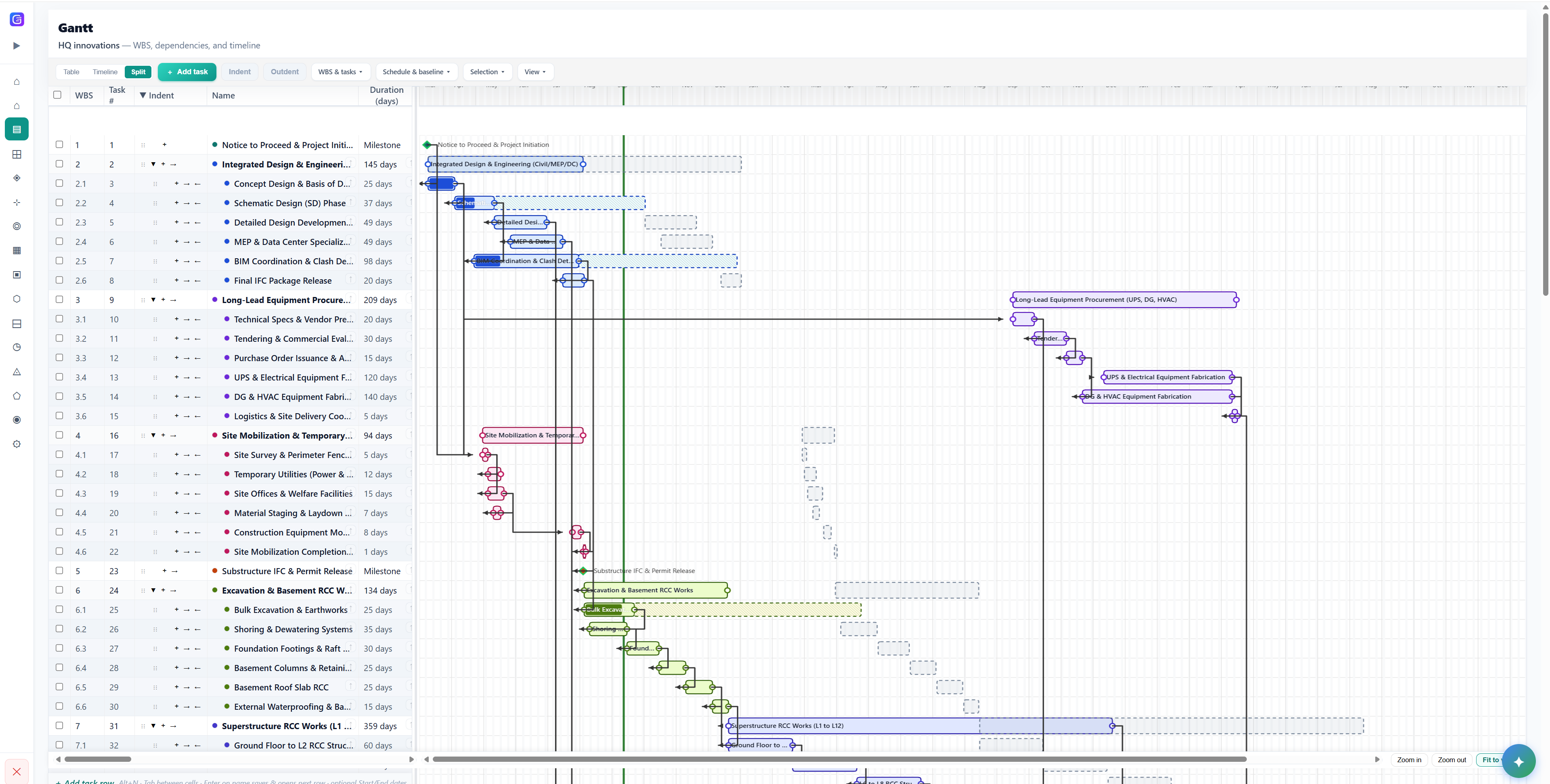
Gantivity keeps CPM fundamentals — dependency and calendar-aware schedules, WBS levels, a Gantt-backed critical path that handles multi-phase programmes with thousands of tasks — and connects them directly to execution. Schedules are generated with AI in Studio from plain-language scope, so a credible network exists for every package, not just the contract programme. Site engineers file daily progress reports from the work face; delay prediction reads those signals and flags trending slips; issues carry priority and severity with configurable auto-escalation; and AI generates status, risk, digest, and variance reports from live data. Any stakeholder can ask ZAI, the in-channel copilot, what's due, what's blocked, or what threatens a milestone — no scheduler queue. That is project controls run daily instead of monthly.