What is AI construction scheduling?
AI construction scheduling is the use of artificial intelligence across the full life of a project schedule: building it, checking it, and keeping it honest during execution. Instead of a scheduler manually creating hundreds of activities, wiring logic links, and re-running the network every month, the AI does the mechanical work — and the humans make the decisions that actually require judgement.
In practice, AI scheduling software for construction should do three distinct jobs:
- Generate: convert scope — a plain-language description, a drawing register, an existing programme — into a structured work breakdown, with dependencies, durations, and working calendars, and compute the critical path.
- Predict: read execution signals from the site (daily progress, issues, blocked tasks) and forecast which activities and milestones are trending late, before the slip becomes contractual.
- Communicate: answer questions about the schedule in plain language, nudge assignees about pending work, and produce status, risk, and variance reports from live data rather than from last week's slide deck.
Gantivity was built to do all three. It is not an add-on assistant bolted onto a legacy planning tool — the AI is native to how schedules are created and how projects are run. If you are evaluating the broader category, our construction project management software page covers planning, field reporting, and communication together.
How AI schedule generation works in Gantivity Studio
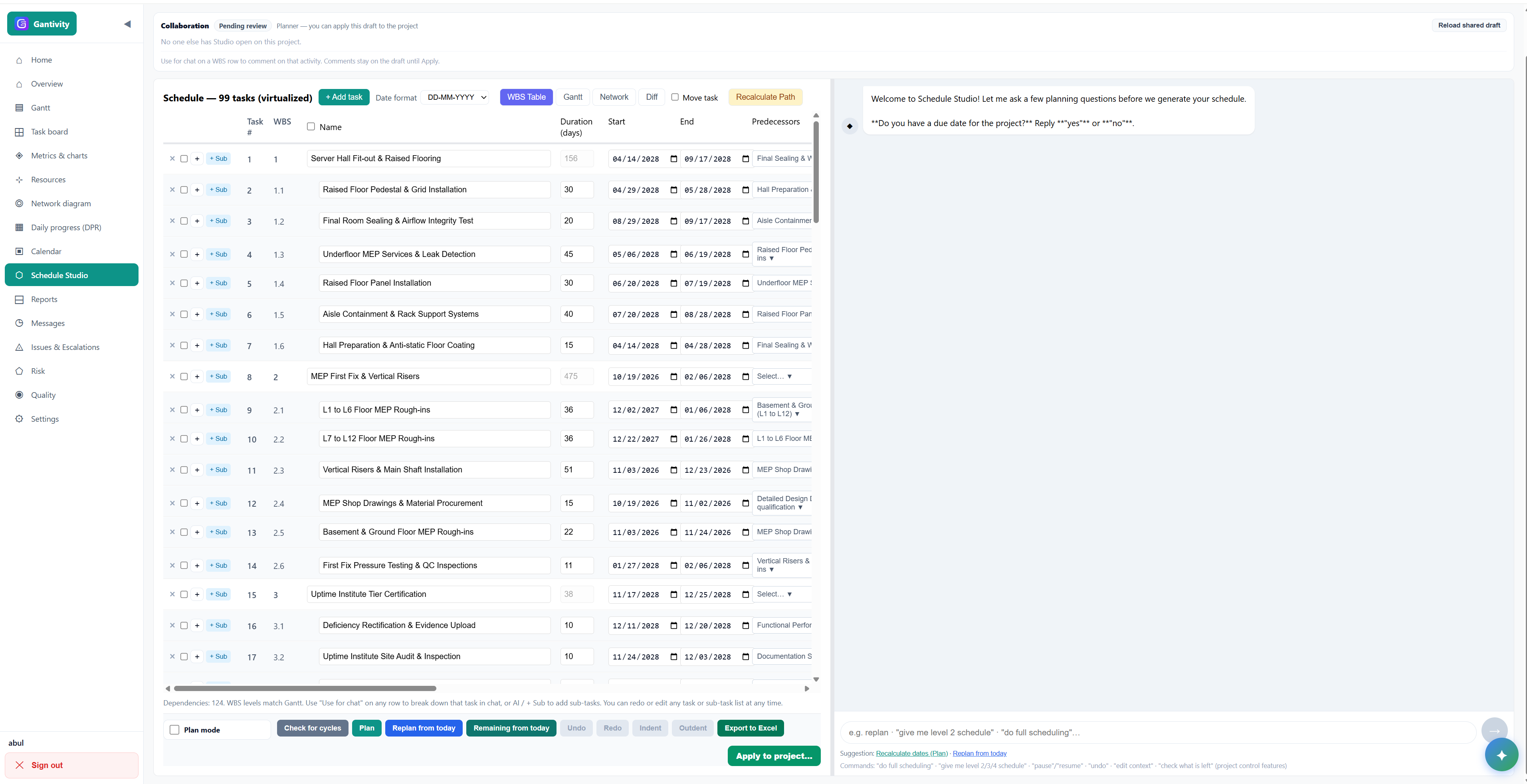
Schedule generation happens in Gantivity Studio. The workflow is deliberately simple, because the point is to remove the barrier between knowing your scope and having a workable programme:
- Describe the scope in plain language. "Twelve-storey residential tower, raft foundation, two basement levels, MEP first fix from level 3 onward, façade starts after structure reaches level 6, monsoon shutdown in July." You can also start from a template or an existing plan.
- The AI proposes a work breakdown structure. Studio builds WBS levels, tasks with realistic durations, finish-to-start and overlapping dependencies, and working calendars that respect your constraints.
- The critical path is computed and stress-tested. Gantivity highlights the driving chain of activities, flags areas where the logic looks fragile or the float is unrealistically thin, and lets you ask "what if this slips?" before you commit dates to a client.
- Iterate with the AI, then baseline. You refine sequencing, adjust durations, and split or merge phases in conversation — the network recalculates as you go. When it holds together, you commit the baseline and move into execution.
A first credible draft typically takes minutes, not weeks. That matters most at the moments schedules usually don't exist: bid stage, early works, subcontractor packages, and recovery planning after a major change.
Delay prediction: from lagging to leading indicators
Most construction schedules fail after the baseline, not before it. The plan is sound on day one; then progress reporting decays into WhatsApp messages and monthly updates, and by the time the schedule is formally revised, the delay is already three weeks old. This is the core argument of our project controls approach: measurement has to be continuous or prediction is impossible.
Gantivity closes that loop with daily progress reports from the field. Site engineers update tasks with notes, percent progress, and time, and can raise issues directly from the work face. Those execution signals feed the delay-prediction layer, which compares actual performance against planned rates and flags tasks, resources, and milestones that are trending late. Predicted slips appear on the Gantt, in dashboards, and through ZAI — the in-channel copilot you can ask "what's delayed this week?" or "which tasks block handover?"
Configurable auto-escalation completes the chain: when a critical issue sits unanswered, Gantivity escalates it through the levels you define, with a log of who was notified and when. Early warning is only useful if someone accountable actually sees it.